

Discover why Sigma II closed panel timber frame could deliver more value, without the cost premium you might expect
For housebuilders, choosing between open panel and closed panel timber frame has traditionally involved a commercial assumption: the more work completed in the factory, the higher the cost.
But what happens when you compare the total cost of both systems at the same stage of construction? Our latest cost comparison challenges that assumption.
Across two assessed house types, Sigma II closed panel timber frame achieved a marginally lower cost per m² than traditional open panel, once the relevant site materials and labour were included.
And with more of the external wall completed in the factory, Sigma II offers additional opportunities to improve programme certainty, reduce site activities and deliver consistent building performance.

The real cost of timber frame is more than the frame
When comparing timber frame systems, the initial supply and installation price tells only part of the story. Traditional open panel timber frame requires additional materials and labour to complete elements of the external wall on site. Sigma II takes a different approach.
With insulation, internal and external sheathing and service zone battens factory fitted, more of the external wall construction is completed before panels arrive on site. That changes the commercial comparison.
The question isn’t simply which timber frame costs less to supply. It’s which system delivers the greatest value at an equivalent stage of construction.
What Does the Cost Comparison Reveal?
We assessed two typical house types, comparing DTS Alpha 2 open panel timber frame with Sigma II closed panel timber frame. Both systems were evaluated to the same construction stage, ready for first fix plumbing and electrical works, including the relevant timber frame supply, installation, site materials and labour.


The finding that changes the conversation
Comparable cost. More completed in the factory. Greater potential delivery value.
The results challenge the assumption that choosing closed panel timber frame necessarily means paying more.
And when the assessed costs are broadly comparable, the wider construction benefits become an important part of the commercial decision.
These results relate to the two specified house types, construction specifications and equivalent completion stage assessed. Actual project costs will vary according to design, specification and project requirements.
Why Choose Sigma II Closed Panel Timber Frame?
Sigma II is more than a different timber frame specification. It changes where and how important construction activities are completed.
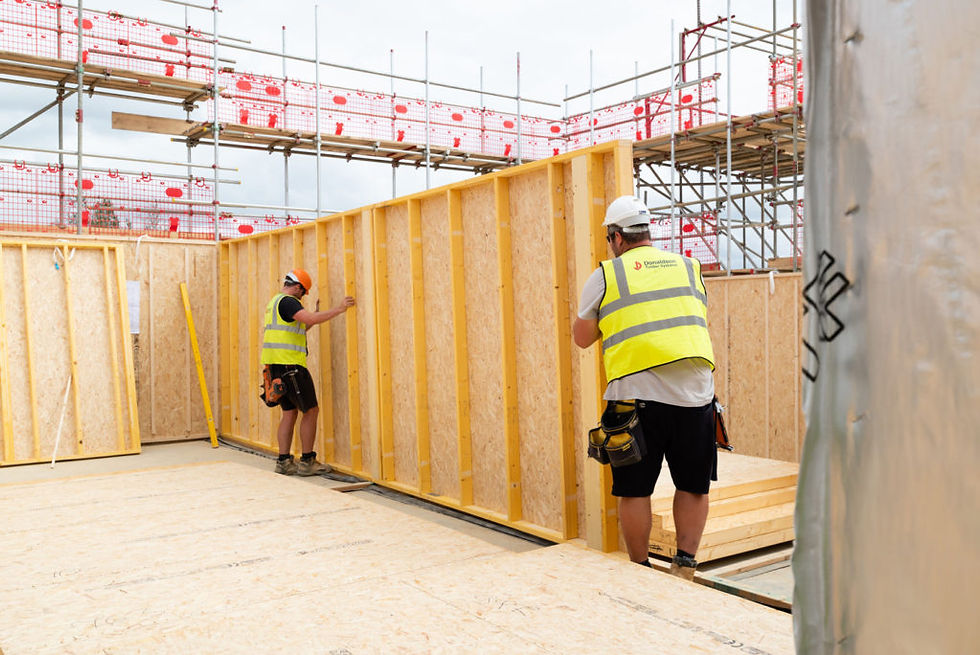
1. Less work to complete on site
With traditional open panel timber frame, insulation, vapour control layers and service battens are among the activities that must be completed on site. Sigma II transfers more of these activities into a controlled manufacturing environment. This reduces the number of external wall completion tasks required after installation and the associated demands on site labour, materials and coordination.
More completed before delivery. Less left to manage on site.
2. A faster, more predictable construction programme
One of the principal advantages of timber frame construction is the opportunity to progress internal and external works in parallel. Sigma II builds on that advantage.
By delivering factory insulated and sheathed panels with service zones already incorporated, the system reduces the activities required between frame installation and first fix. For housebuilders, this creates opportunities to bring internal trades forward, simplify construction sequencing and improve programme predictability.
The programme advantage begins before the panels reach site.


3. Greater quality and consistency
Building performance depends on how effectively the external wall is constructed, insulated and detailed. Sigma II incorporates factory fitted insulation, internal and external sheathing and a protected airtightness layer behind the service zone.
Completing these elements in a controlled manufacturing environment supports consistent installation, reduces exposure to site variability and helps protect the integrity of the intended wall specification.
Quality is built into the manufacturing process, not left entirely to site conditions.
4. Reduced Site Labour and Coordination
Every additional site activity requires labour, materials, supervision and coordination with other trades. By transferring more work into timber frame manufacturing, Sigma II can reduce the number of activities housebuilders need to manage after frame installation.
This is particularly relevant when skilled labour availability, programme pressures and construction costs are influencing delivery decisions.
Fewer site activities. A more streamlined construction process.


5. Fewer deliveries and less material handling
Factory completion also reduces the need to deliver and handle certain external wall materials separately on site. With more components incorporated into the panels before dispatch, there are opportunities to reduce material storage, handling and associated waste.
For busy housing developments, this can support more efficient site logistics and coordination.

Open Panel or Closed Panel Timber Frame: Which Is Right for Your Development?
Both systems have an important role in modern housebuilding. Open panel timber frame offers a familiar construction approach, with elements of the external wall completed by site teams.
Sigma II closed panel timber frame offers a greater degree of factory completion, reducing the work remaining after installation. The right choice depends on your development, specification, programme and commercial priorities.
But our latest assessment demonstrates why closed panel should not be discounted on the assumption that it will necessarily cost more. The best way to understand the opportunity is to compare both approaches against your actual project requirements.

Discover what Sigma II could deliver for your next project
At Donaldson Timber Systems, we bring more than 50 years of timber frame experience to the design, manufacture and delivery of homes across the UK. Our technical and commercial teams work with housebuilders to evaluate construction methods, specifications, buildability and programme requirements.
Whether you’re already using open panel timber frame or considering closed panel construction for the first time, we can help you understand the commercial and practical implications of choosing Sigma II.
Could your next development benefit from more factory completion without the expected cost premium?


